
Last Updated: October 26, 2026
Quick Summary
Professional stone sealer is worth it when the stone is porous, in a high-traffic or wet area, and expensive to replace. It is rarely worth it on dense, polished surfaces that already resist water. Run the water droplet test first: if water beads, sealing is optional.
- Place water drops on stone and watch for ten minutes; absorption means sealing will help.
- Wait at least 24 hours after cleaning before testing, since residual cleaner can repel water.
- Professional jobs should include a moisture check, test patch, masking and written product record.
- Stone sealer typically lasts between one and five years depending on product, stone and traffic.
- Solvent-based sealer such as Jackstone covers roughly 20 to 25 square metres per litre.
Table of Contents
- Is Professional Stone Sealer Worth It? The Real Decision Factors
- How to Test If Stone Needs Sealing Before You Spend Anything
- Professional Stone Sealing vs DIY: Costs, Risks and Results
- Stone Sealer Cost per Square Metre and What Drives It
- How Long Does Stone Sealer Last, and Why Resealing Economics Matter
- Choosing a Sealer by Stone Type, Location and Use
- Frequently Asked Questions
Is Professional Stone Sealer Worth It? The Real Decision Factors
Professional stone sealing is worth it when the stone is porous, in a high-traffic or wet area, and expensive to replace.
At Kemistone, we supply both trade installers and homeowners, and the question we hear most is whether a professional-grade stone sealer and proper application beats a cheap tin from a DIY shed.
Below, we break down the tests that tell you whether sealing is needed, what professional sealing covers, and how costs stack up against DIY.
Historic England guidance on caring for stone surfaces
How to Test If Stone Needs Sealing Before You Spend Anything
The water droplet test is the fastest way to know. Place a few drops of water on an inconspicuous patch and watch for ten minutes. If the water beads on top, the stone is already protected or naturally dense.
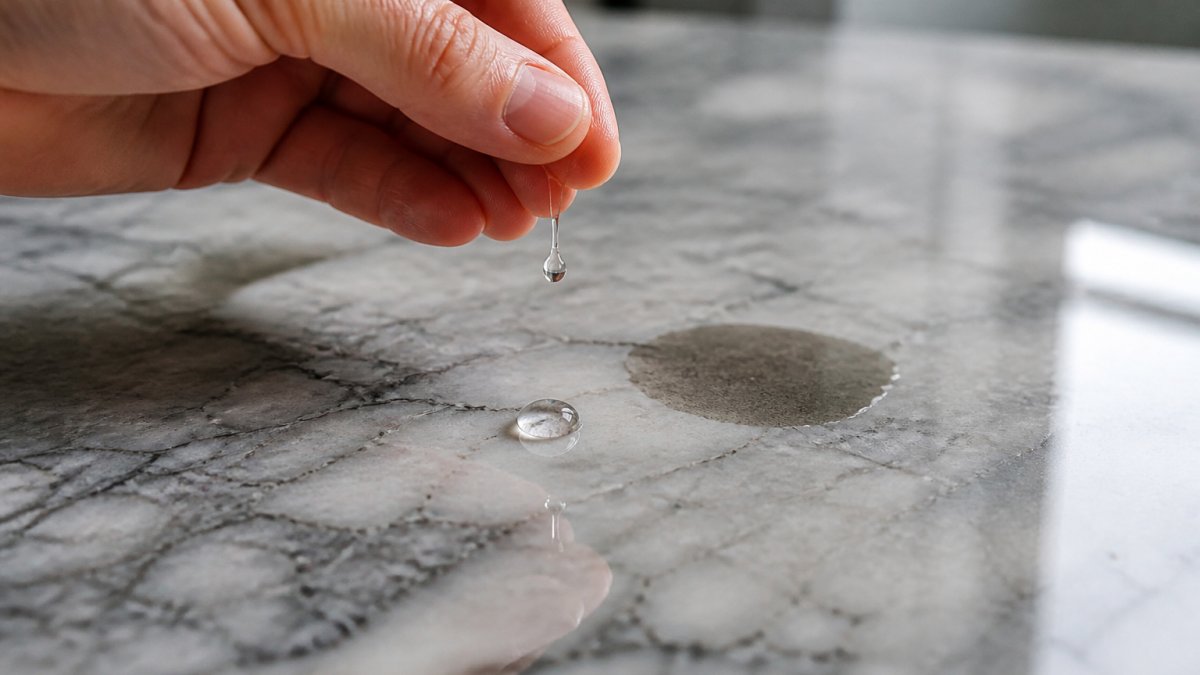
The Water Droplet Test
Run the test in three or four spots, because absorption varies across a single slab. Testing on a freshly cleaned surface gives a false reading, since residual cleaner can repel water temporarily, wait at least 24 hours after cleaning.
Porosity, Absorption and Stone Type
Porosity is the measure of how much open space exists inside a stone for liquid to fill. Limestone and sandstone are typically more absorbent than granite or polished marble, so they benefit most from a penetrating sealer. Once the droplet test confirms absorption, a concentrated water-based option gives you a product to act on immediately.
Professional Stone Sealing vs DIY: Costs, Risks and Results
Professional sealing costs more upfront but usually wins on consistency and product quality. DIY is cheaper on materials but carries real risk: uneven coverage, missed edges, and sealers applied too thickly that leave patchy sheen or slippery patches. Compare the two over a full resealing cycle, not at the till.
What Professional Sealing Actually Covers
A proper professional job includes surface preparation, moisture checks, masking of adjacent surfaces, controlled application, and a cure period before use. Ask any contractor what preparation they do. If the answer is vague, walk away.
A credible scope of work should include, as a minimum:
- A moisture check with a meter before any product is opened, because sealing damp stone traps moisture and causes clouding.
- Identification of the stone and its finish (polished, honed, brushed, tumbled), since this determines whether a penetrating or topical sealer is appropriate.
- A test patch in an inconspicuous area, allowed to cure, then checked for colour change, sheen and slip resistance before full application.
Ask for the product and safety data sheets before work starts; a contractor who cannot produce them is not applying a trade-grade product in a controlled way.
Where DIY Sealing Goes Wrong
The most common mistakes are applying to a damp surface, over-applying until the sealer pools, and skipping a test patch. Sealing over a damp floor traps moisture and can cause a cloudy finish that is difficult to remove. Other frequent failure modes include:
- Residue and haze from failing to wipe off excess penetrating sealer before it dries, which can require a dedicated stripper to correct.
- Uneven appearance from overlapping passes or from applying a single coat too thickly instead of two thin coats.
- Trapped moisture where stone has been cleaned or rained on within the preceding 24 to 48 hours.
None of these are catastrophic on a small bathroom splashback. On a large limestone floor or an expensive worktop, correcting them can cost more than the original professional quote.
The Real Cost Comparison
The upfront comparison is straightforward: DIY is product plus your time; professional is product plus labour plus, usually, a call-out or minimum charge. The more useful comparison is over a full resealing cycle, where the two routes diverge.
| Factor | Professional Sealing | DIY Sealing |
|---|---|---|
| Upfront cost | Higher (labour + product) | Lower (product only) |
| Consistency of coverage | Even, checked | Varies with technique |
| Product grade | Trade-grade | Often retail-grade |
| Risk of error | Low | Moderate to high |
| Best for | Large areas, expensive stone | Small areas, confident DIYers |
| Reseal interval | Typically longer with trade-grade product | Often shorter with retail-grade product |
| Cost of correcting a failure | Borne by contractor | Borne by you |
Two cost mechanics matter more than the headline price. First, coverage rate: a porous stone drinks more product, so the same area costs more in materials whichever route you take. Second, reseal frequency: a product reapplied every year costs more over a decade than a durable one applied every three to five years, even if the tin price is higher. Browse our range of sealers to compare coverage rates and stated durability directly.
Stone Sealer Cost per Square Metre and What Drives It
Stone sealer cost per square metre depends on stone porosity, coverage rate, and whether labour is included. A more porous stone drinks more product, so the same area costs more to seal.
Coverage rates vary by product. A solvent-based sealer such as Jackstone stone sealer solvent based covers roughly 20 to 25 square metres per litre, while more absorbent stone falls toward the lower end of any stated range.

How Long Does Stone Sealer Last, and Why Resealing Economics Matter
Stone sealer typically lasts between one and five years, depending on the product, the stone, and foot traffic. The resealing interval decides the true cost, not the tin price: a cheap sealer reapplied every year often costs more over a decade than a durable one applied less often.
To judge resealing economics, look at durability characteristics rather than headline price. Water-repellent products with UV resistance hold their performance longer outdoors. If you want to weigh long-term value, review water repellants and their stated durability before committing.
Choosing a Sealer by Stone Type, Location and Use
Match the sealer to the stone and where it sits. A polished marble worktop indoors has different needs from a porous limestone floor or granite exterior steps.
The more useful question is which combination of stone, location and use actually justifies paying for professional application. The matrix below is the framework we use when advising trade customers.
| Stone and finish | Typical porosity | Location and use | Sealer type | Professional worth it? |
|---|---|---|---|---|
| Polished marble or granite | Low | Indoor worktop, low spill risk | Penetrating, solvent or water-based | Usually no, test first |
| Honed limestone or sandstone | High | Indoor floor, high traffic | Penetrating, breathable | Usually yes |
| Tumbled travertine | Medium to high | Bathroom or wet room | Penetrating, mould-resistant | Usually yes |
| Slate | Low to medium | Indoor floor or hearth | Penetrating or colour-enhancing | Depends on finish and area |
| Granite or sandstone paving | Medium | Outdoor patio, steps | Penetrating, UV-stable, breathable | Yes on large areas |
| Polished marble | Low | Outdoor steps or cladding | Penetrating, UV-stable | Yes, frost and staining risk |
Three rules sit behind the matrix:
- Interior worktops and splashbacks. If the droplet test shows beading, sealing is optional. If it shows absorption, a penetrating sealer is appropriate, but the area is usually small enough that DIY is viable provided you use a test patch and two thin coats.
- Wet rooms and showers. Moisture is constant, so breathability matters as much as water repellency. A sealer that traps moisture under the surface can lead to efflorescence or discolouration. Professional application is usually justified because the cost of correcting a failed seal in a wet area is high.
- Exterior paving and steps. UV stability and breathability are non-negotiable. A topical sealer that yellows or blisters in sunlight is a costly mistake on a patio. Large exterior areas also involve access, masking and weather-window judgement that most homeowners cannot manage reliably.
For most indoor worktops and floors, a penetrating, non-yellowing formula is the safer choice. Once professional sealing is worth it, browse our high quality sealers suited to your stone and setting, and confirm the product matches your stone type before ordering.
Frequently Asked Questions
Is professional stone sealing worth the cost compared with a DIY sealer?
It depends on the stone and the risk. A professional service adds labour, surface preparation and inspection on top of the sealer itself, so it costs more than buying a tin and applying it yourself. That premium earns its place when the stone is high-value marble, has previous coatings or repairs, or sits in a high-traffic commercial space where a failed application is expensive to reverse. For a straightforward, low-porosity floor in good condition, a professional-grade stone sealer applied carefully by a competent DIYer can deliver similar protection for less.
How much does stone sealer cost per square metre?
Work it out from coverage rather than from the tin price. Kemistone's Kingstone covers 10-15 sqm per litre at £44.00, which puts the material cost at roughly £3 to £4.40 per square metre per coat. Jackstone covers 20-25 sqm per litre at £165.00, around £6.60 to £8.25 per square metre. Escudo covers 10-15 sqm per litre on textured surfaces and 20-25 sqm per litre on polished ones at £110.00. Porosity, number of coats and surface preparation all shift the final figure.
How long does stone sealer last before you need to reseal?
There is no single lifespan, and any supplier quoting one fixed number is oversimplifying. Durability depends on the sealer chemistry, the stone's absorption, foot traffic and whether the surface is indoors or exposed to weather. Solvent-based products such as Kingstone and Jackstone are formulated for durability and UV resistance, and water-based Kingstone Plus is described as extremely durable and non-yellowing. The practical answer is to retest with a water droplet every six to twelve months and reseal when the water stops beading.
Can stone sealer change the colour or appearance of natural stone?
A penetrating or impregnating sealer should leave the surface looking unchanged. Kemistone's Kingstone, Kingstone Plus, Querz, Jackstone and Escudo are all described as not changing the colour or features of the treated stone, and several carry a slight amber hue in the tin that turns invisible once applied. Topical sealers and surface coatings are the ones that can add sheen or darken the stone. Always run a small test patch first, particularly on marble, and check the finish in daylight before treating the whole surface.
The challenge is choosing the right sealer for your specific stone, not just any sealer. Kemistone engineers professional-grade treatments through laboratory and practical testing, with hydro-repellent protection, anti-slip properties, and UV-resistant formulas that will not discolour. Get started with Kemistone and protect your stone surfaces with products built for the job.
