
Last Updated: October 28, 2026
Quick Summary
How often you reseal natural stone depends on its porosity and location: dense stone such as polished granite every 3-5 years, marble or slate every 1-2 years, limestone or sandstone every 12-18 months, and wet areas checked every 6-12 months. The only reliable way to know is the water-drop test, since high-traffic zones wear first.
- The water-drop test takes minutes: place three or four drops and watch for up to ten minutes.
- Water that darkens or sinks in within one to five minutes means the sealer has largely failed.
- Let stone dry fully after cleaning, often 24-48 hours, before applying sealer.
- Wipe off surplus sealer before it tack-dries, as leftover excess causes haze and sticky residue.
- Querz solvent-based sealer covers 10-20 sqm per litre depending on porosity.
Table of Contents
- How Often to Reseal Natural Stone: The Honest Answer
- How to Test If Natural Stone Needs Sealing
- How Long Does Natural Stone Sealer Last?
- How to Seal Natural Stone Tiles Without Mistakes
- Frequently Asked Questions
How Often to Reseal Natural Stone: The Honest Answer
Ask five stone professionals how often to reseal natural stone and you will get five answers.
A busy kitchen worktop may need attention sooner than a hallway floor, and porous limestone may absorb sealer more readily than polished granite. The number on the tin is a starting point, not a rule.
Here is the short version:
- Dense stone such as polished granite: every 3-5 years
- Medium-porosity stone such as marble or slate: every 1-2 years
- Porous stone such as limestone or sandstone: every 12-18 months
- Wet areas such as bathrooms and kitchens: check every 6-12 months
That table is a guide, not gospel. If you already know you need to reseal, you can browse the stone sealer products available to buy. The only reliable way to know is to test the stone itself. For stone affected by moisture or salt, Ristop prevents rising water and salts in natural stone.
The article gives these starting-point frequencies by stone type and location.
| Stone or area | Reseal frequency |
|---|---|
| Dense stone such as polished granite | Every 3-5 years |
| Medium-porosity stone such as marble or slate | Every 1-2 years |
| Porous stone such as limestone or sandstone | Every 12-18 months |
| Wet areas such as bathrooms and kitchens | Check every 6-12 months |
How to Test If Natural Stone Needs Sealing
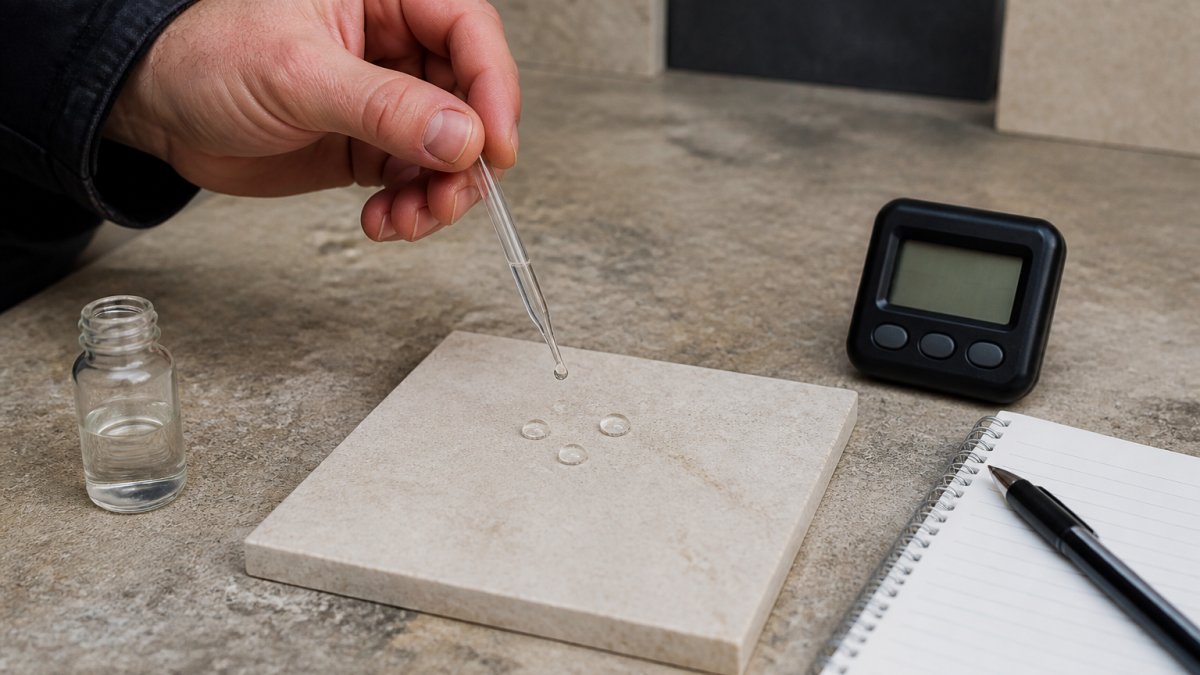
The water-drop test is one check you can run, and it takes minutes.
- Clean and dry the surface with a natural stone cleaner suited to your material; dirt and moisture skew the reading.
- Place three or four same-size drops of water on the surface from a pipette or clean fingertip.
- Start a timer immediately and watch the water for up to ten minutes.
- Beads and sits proud for ten minutes or more: the sealer is intact.
- Beads then flattens within five to ten minutes: the sealer is weakening. Plan to reseal within a few months, especially in wet areas.
- Darkens or sinks in within one to five minutes: the sealer has largely failed. Reseal before the stone absorbs oils, wine, or cleaning chemicals.
- Absorbs almost immediately: the stone is unprotected. Reseal as soon as the surface can be cleaned and dried.
Run the test in three or four locations, not one. High-traffic zones wear first: a worktop near the sink, a floor by a doorway, or a shower tray will fail long before the far end of the room.
If you need a cleaner before testing, browse our natural stone cleaners range.
How Long Does Natural Stone Sealer Last?
If you are weighing up durability, our Querz solvent-based sealer is built for quartzite, granite and alkaline silicate materials, with coverage of 10-20 sqm per litre depending on porosity.

How to Seal Natural Stone Tiles Without Mistakes
- Clean thoroughly. Strip old sealer and dirt with a cleaner appropriate to the stone. Rinse and let the stone dry fully; drying often takes 24-48 hours, and porous stone may need longer.
- Test a small patch. Apply sealer to an inconspicuous area first, check it suits the stone and does not change its colour or finish, and wait for the full cure before judging.
- Ventilate the space. Open windows and doors, and wear appropriate gloves; solvent-based sealers need good airflow (Construction hazardous substances: Solvents).
- Apply thinly and evenly. Use a roller or brush. One even coat beats a heavy one, so work in small sections to control coverage.
- Let it soak in. Penetrating sealers need time to absorb; follow the dwell time on the label.
- Remove excess before it dries. Wipe off surplus sealer with a clean, dry cloth before it tack-dries; leftover excess is the most common cause of haze and sticky residue.
- Cure properly. Keep the surface dry for the full curing window on the label, avoiding foot traffic and water.
- Haze or cloudiness: usually excess sealer or sealer applied to damp stone. Buff with a clean cloth and, if needed, use a suitable sealer remover before reapplying.
- Streaks: caused by uneven application or a partly dry roller. Apply in straight, overlapping lines and keep a wet edge.
- Sticky residue: excess sealer not removed. Wipe down with a recommended cleaner and allow to cure fully.
- Uneven absorption: porous stone drinks sealer at different rates. A second thin coat may be needed on the most absorbent areas, but only after the first has cured.
For marble, stone, limestone and stone composites, our Kingstone sealer gives water and oil repellent protection without changing the stone's colour or finish. For quartzite, granite, terracotta, concrete and alkaline silicate-based materials, our Querz solvent-based sealer gives water and oil repellent protection and covers 10-20 sqm per litre depending on porosity.

Frequently Asked Questions
How often should you reseal natural stone?
It depends on the stone and where it sits. Dense granite and quartzite in a hallway may go 3-5 years between coats, while porous limestone or travertine in a bathroom often needs attention every 12-18 months. Polished marble worktops in a busy kitchen usually fall in the 1-2 year band. Rather than following a fixed calendar, check the surface with a water-drop test and reseal when water stops beading and starts soaking in.
What happens if you don't seal a natural stone surface?
Unsealed or worn stone absorbs whatever lands on it. Oil, red wine, coffee and cleaning chemicals can wick into the pores and leave stains that sit below the surface, where ordinary cleaning cannot reach them. In wet areas, water penetration can also feed efflorescence and, on exterior steps, encourage moss and lichen growth. Sealing does not make stone waterproof, but it buys you time to wipe spills before they become permanent.
Does the type of stone affect how often it needs resealing?
Yes, porosity is the main variable. Marble, limestone, travertine and sandstone absorb more readily and generally need resealing sooner than granite, quartzite or slate. Finish matters too: a honed or tumbled surface holds sealer differently from a polished one, and outdoor stone exposed to rain and frost will need reapplication more often than an indoor floor. Match the sealer to the stone's absorption rather than buying one product for everything.
Sealing stone is not about following a calendar. It is about reading the surface and matching the product to the material.
Kemistone builds professional-grade treatments for exactly that job. Our sealers offer hydro-repellent protection, resist UV discolouration, and stay invisible on the stone. Whether you maintain marble worktops, limestone floors, or granite steps, we have a product for the material.
Get started with Kemistone and keep your stone looking like new for longer.
