
Last Updated: November 4, 2026
Quick Summary
The best professional stone sealer for marble depends on absorption and exposure. For polished worktops, a solvent-based impregnating sealer such as Kingstone gives water and oil repellency without changing the finish, while Kingstone Plus offers a breathable water-based option for medium to high absorption floors and cladding.
- Impregnating sealers soak into the stone and cure within it, rather than coating the surface.
- Kingstone covers 10-15 sqm per litre, depending on porosity, and costs £44.00.
- Jackstone is a solvent-based sealer with coverage of 20-25 sqm per litre.
- No sealer makes marble acid-proof, because acids etch calcium carbonate regardless.
- Water should bead on the surface once cured; when beading stops, reapply.
Table of Contents
- What Separates Professional Marble Sealers From Retail Options
- Comparing Kemistone Marble Impregnating Sealer Products
- Choosing a Marble Sealer for Floors, Worktops and Cladding
- How to Seal Marble: Preparation, Application and Curing
- Frequently Asked Questions
What Separates Professional Marble Sealers From Retail Options
Impregnating sealers are generally formulated for the stone's porosity, and the choice depends on the stone and its exposure. Browse the range of professional-grade sealers to see what's available beyond retail options. Impregnating sealers penetrate the surface rather than coating it.
Film-forming sealers sit on the surface, while impregnating sealers soak into the stone and cure within it. Calcite-based marble is softer and more acid-sensitive than granite.
Historic England guidance on caring for stone surfaces makes the same point about vapour permeability: stone needs to breathe, and any treatment that seals moisture in will eventually cause problems.
Comparing Kemistone Marble Impregnating Sealer Products
Kemistone offers four impregnating sealers suited to marble; the choice comes down to stone absorption and whether you need oil resistance as well as water resistance. View the Kingstone product details to evaluate it against the alternatives.

Kingstone (£44.00) is our solvent-based water and oil repellent sealer for marble, limestone and stone composites. It is invisible when applied, resistant to UV rays, and covers 10-15 sqm per litre, depending on porosity.
Kingstone Plus (£215.00) is the water-based option for medium to high absorption stone, giving an oil repellent seal on floors and cladding of marble, granite, quartzite, limestone and sandstone. It is breathable, UV resistant and will not yellow.
Jackstone (£165.00) is a solvent-based sealer for worktops, floors and cladding of marble or granite, with coverage of 20-25 sqm per litre, depending on porosity.
Escudo (£110.00) is a neutral waterproof acid sealer on hydrocarbon solvents for countertops, floors around swimming pools and cladding on marble, granite, porphyry, travertine and cement. It is recommended as a preventative against efflorescence, mould, algae and acid rain damage.
| Product | Base | Oil Resistance | Coverage | Price |
|---|---|---|---|---|
| Kingstone | Solvent | Yes | 10-15 sqm/litre | £44.00 |
| Kingstone Plus | Water | Yes | 10-15 sqm/litre | £215.00 |
| Jackstone | Solvent | Yes | 20-25 sqm/litre | £165.00 |
For a closer look at the solvent-based option, view the Jackstone stone sealer solvent based specification. If you are weighing the water-based route for a porous floor, compare the Kingstone Plus details before you commit.


Choosing a Marble Sealer for Floors, Worktops and Cladding
Match the sealer to the surface and the threat: polished worktops face oil, wine and citrus; honed floors face foot traffic and water; exterior cladding faces rain, frost and UV.
For polished marble worktops, a solvent-based impregnating sealer such as Kingstone is suitable. It is invisible when applied and will not change the features or colour of the surface.
For honed marble and stone floors, Kingstone Plus is designed for stone with medium to high absorbance and is breathable.
For cladding and exterior work, Escudo is recommended as a preventative against efflorescence, mould, algae and acid rain damage. Ristop (£18.00) is a specialist product applied during laying to the surfaces in contact with adhesive, designed to prevent rising water and salts; it works particularly well on white marble used externally.
One warning worth stating plainly: no sealer makes marble acid-proof. Marble is calcium carbonate, and acids etch it regardless of what you apply. Sealer buys you time to wipe up a spill. It does not stop the chemical reaction.
Ready to match a product to your surface? browse the marble sealer range to see the full specification for each option.
How to Seal Marble: Preparation, Application and Curing
Sealing marble takes a clean, dry surface, a thin uniform coat, and time to cure. Rushing any of the three is the most common reason a sealer underperforms.
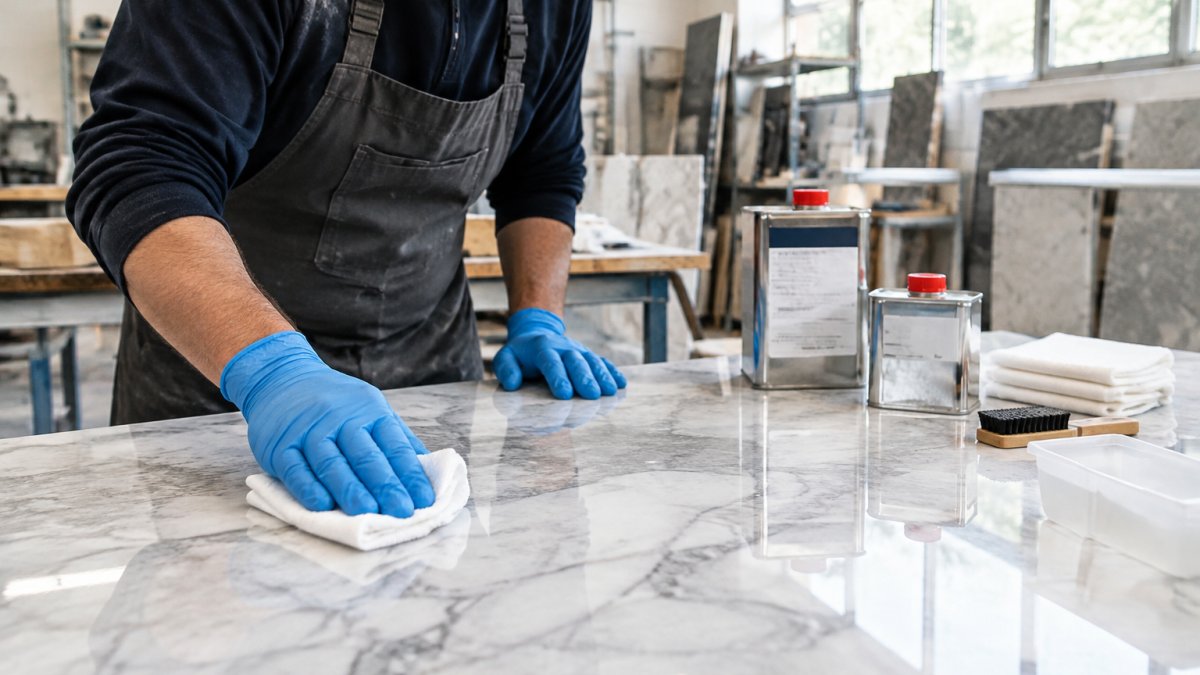
Step 1: Clean and dry the stone. Remove all dirt, grease and old sealer residue. Marble must be fully dry, because trapped moisture blocks penetration.
Step 2: Test a small area. Testing a small area first is recommended for these products. Check that the finish and colour are unchanged once cured.
Step 3: Apply a thin, uniform coat. Apply by brush, roller or spray, as suited to the product.
Step 4: Allow absorption. Let the sealer soak in for the label's dwell time, then wipe off any excess before it dries on the surface.
Step 5: Cure before use. Keep the surface dry for the full curing window. For Ristop, allow at least 6 hours to dry before laying.
Step 6: Check water beading. Once cured, water should bead on the surface. When beading stops, it is time to reapply.
How long does marble sealer last? Durability depends on the product, the stone's porosity and the traffic the surface sees.
Frequently Asked Questions
Do professionals use penetrating or topical sealer on marble?
Penetrating, or impregnating, sealers are the standard choice for marble because they sit inside the stone's pores rather than forming a film on top. Kemistone's range, including Kingstone and Kingstone Plus, is impregnating: both are described as leaving the stone's colour and surface features unchanged.
Can you use the same marble sealer on polished and honed surfaces?
Often yes, but coverage differs sharply. Escudo, for example, covers 10-15 sqm per litre on textured surfaces and 20-25 sqm per litre on polished ones, because a polished face absorbs less. Honed marble is more porous and will drink more product, so budget accordingly. Testing a small area first is recommended for these products.
How long does marble sealer last before reapplication?
There is no single figure, because longevity depends on foot traffic, cleaning products and whether the stone is indoors or exposed. Durability depends on foot traffic, cleaning products and whether the stone is indoors or exposed.
Marble that has been sealed correctly looks after itself; marble that has not will show every spill within a season. If you want protection engineered for the stone rather than a general-purpose film, Kemistone supplies solvent-based and water-based impregnating sealers with stated coverage, UV resistance and breathable performance. Get started with Kemistone and give your marble the protection it was specified for.
